
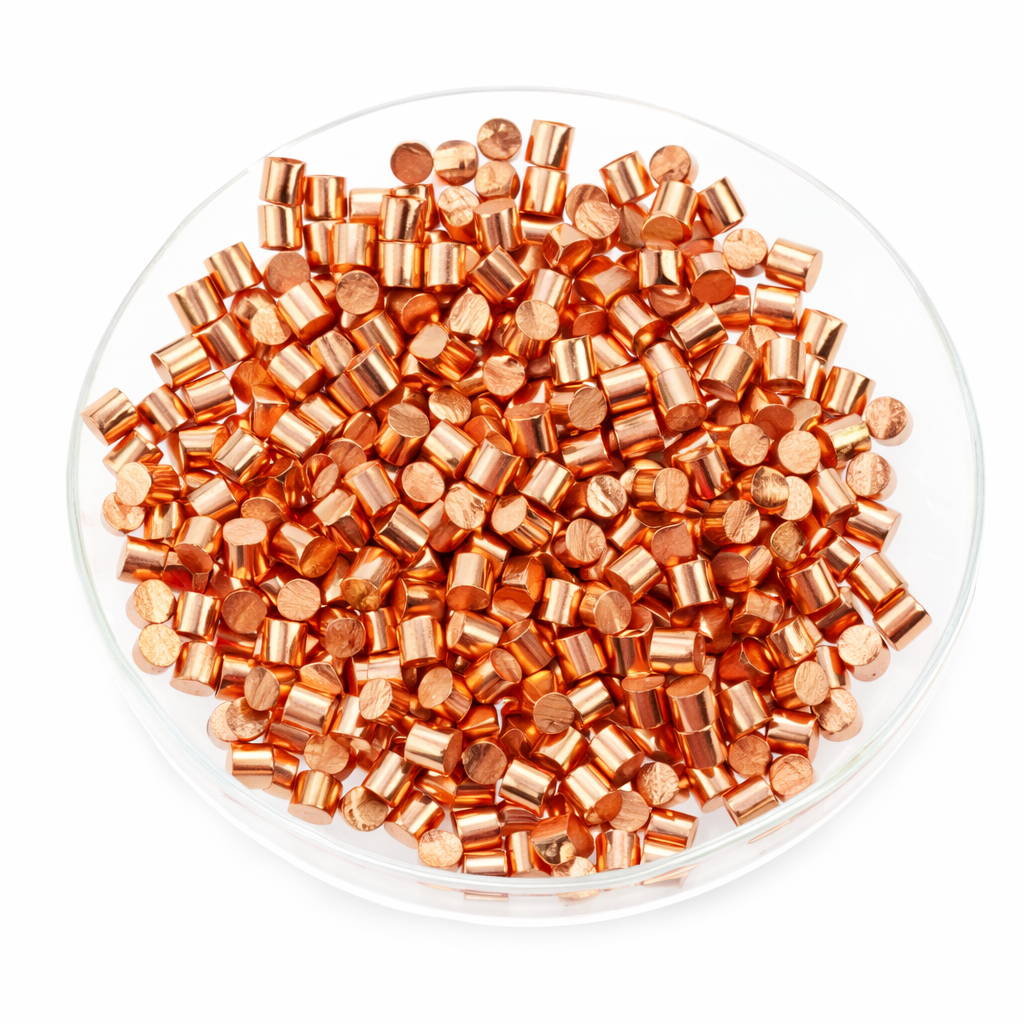
Copper (Cu) Pellets, Evaporation Grade, Cylindrical
Price range: £70.99 through £245.99
Dispatch normally within 1 business day; carrier transit normally 6–8 business days (7–9 business days in total). See Shipping Policy and Returns Policy.
For research and laboratory use only. Not for medical, diagnostic or household use.
Copper (Cu) Pellets, Evaporation Grade, Cylindrical
Nanostore’s Copper (Cu) Pellets are high-purity cylindrical evaporation source material for thermal and electron-beam (e-beam) physical vapor deposition (PVD) of copper thin films. Each pellet is precision-cut to uniform dimensions for consistent loading and controlled evaporation behavior in standard thermal boats, crucible liners, and e-beam pocket hearths. Copper thin films deposited from these pellets exhibit high electrical and thermal conductivity, high electromigration resistance, and strong adhesion to common substrates with appropriate adhesion layers. Sold by net weight; each package contains multiple pellets. Available in 99.99% (4N) and 99.999% (5N) purity grades, with multiple pellet dimensions and package weights to suit different deposition system capacities and throughput requirements. Custom pellet dimensions, higher purities (up to 99.9999%), spherical forms, and irregular pieces are available upon request.
MATERIAL SPECIFICATIONS:
Material: copper (Cu)
CAS number: 7440-50-8
Purity options: 99.99% (4N), 99.999% (5N)
Pellet shape: cylindrical
Available sizes: φ3 mm × 3 mm (1/8 inch dia × 1/8 inch length); φ6 mm × 6 mm (1/4 inch dia × 1/4 inch length)
Package sizes: 50 g, 100 g (multiple pellets per package)
Appearance: metallic reddish-pink cylindrical pellets
Melting point: 1,085 °C (1,985 °F)
Density: 8.96 g/cm³
Deposition method: thermal evaporation, e-beam evaporation
COMMON APPLICATIONS: Thermal and e-beam evaporation of copper thin films for semiconductor interconnect seed layers and metallization; electrode fabrication in MEMS, sensors, and microelectronic devices; conductive layer deposition in solar cell and photovoltaic research; copper seed layers for subsequent electroplating processes; optical and decorative coatings; alloy preparation and materials research; research-grade thin film studies in materials science, physics, and electrical engineering laboratories.
USAGE NOTES: Load pellets into a clean tungsten boat, molybdenum boat, or e-beam crucible liner. For thermal evaporation, ramp source temperature gradually; copper wets tungsten and molybdenum boats well at evaporation temperature. For e-beam evaporation, use a graphite or ceramic crucible liner to prevent copper alloying with the copper hearth. Recommended base pressure before deposition: ≤5 × 10⁻⁶ Torr. Use high-purity argon or nitrogen backfill if reactive deposition is not desired. Store pellets in the original sealed container in a clean, dry environment. Copper may develop a thin surface oxide during storage; this does not affect evaporation performance, as the oxide dissociates at deposition temperature. For applications requiring zero oxide content, store under inert atmosphere.
Specifications
| Material | copper (Cu) |
|---|---|
| Purity options | 99.99% (4N), 99.999% (5N) |
| Pellet shape | cylindrical |
| Available sizes | φ3 mm × 3 mm (1/8 inch dia × 1/8 inch length); φ6 mm × 6 mm (1/4 inch dia × 1/4 inch length) |
| CAS number | 7440-50-8 |
| Appearance | metallic reddish-pink cylindrical pellets |
| Density | 8.96 g/cm³ |
| Melting point | 1,085 °C (1,985 °F) |
Typical properties of the bulk material (literature values)
| Chemical formula | Cu |
|---|---|
| Molar mass | 63.55 g/mol |
| Boiling point | 2835 K |
Source: PubChem (U.S. National Library of Medicine). Reference values for the bulk substance, not test results of a specific lot.
| Option 1 | 99.99% (4N) / φ3 mm × 3 mm / 50 g net weight, 99.99% (4N) / φ6 mm × 6 mm / 50 g net weight, 99.999% (5N) / φ3 mm × 3 mm / 100 g net weight |
|---|
Related products
-
Titanium (Ti) Evaporation Pieces, 99.7%-99.999% Purity
SKU: TI-PEL-2N7-5NPrice range: £137.99 through £788.99 -
Zinc (Zn) Pellets And Pieces, 99.995%-99.999% Purity
SKU: ZN-PEL-4N5-5NPrice range: £128.99 through £284.99 -
Chromium (Cr) Pellets And Pieces, 99.5%-99.99% Purity (Request Current Price)
SKU: CR-PEL-2N5-4NPrice upon request -
Silicon (Si) Pellets And Pieces, 99.999%-99.9999% Purity
SKU: SI-PEL-5N-6NPrice range: £136.99 through £326.99