
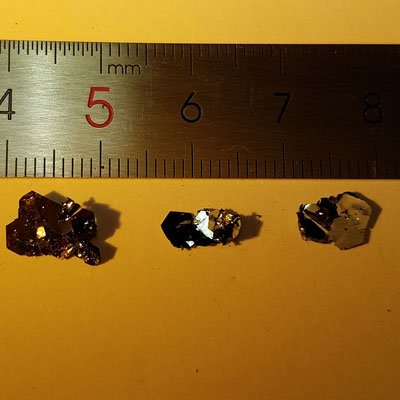
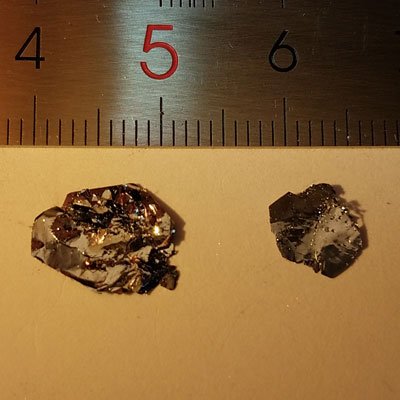
W-Doped MoSe₂ Crystals
W-doped MoSe₂ is a layered transition metal dichalcogenide (TMDC) with a van der Waals structure. Tungsten doping modifies the electronic band structure, charge-carrier mobility, and optical and catalytic properties, supporting optoelectronics, energy storage, and quantum material studies.
Sample Size Options:
Crystals larger than 10 mm²
Crystals larger than 25 mm²
Crystals larger than 100 mm²
Material Properties:
Layered van der Waals Structure: Facilitates exfoliation into thin layers for 2D research and applications.
Bandgap Engineering: Tungsten doping permits fine-tuning of the bandgap and electronic properties.
Charge Carrier Mobility: Electronic transport applicable to optoelectronic devices.
Optical Absorption: The material absorbs light in the visible-to-infrared spectrum for photonic applications.
Crystal Structure:
Type: Hexagonal layered structure
Features: Cleavable layers, applicable for thin-film fabrication and nanoscale device research.
Degree of Exfoliation:
Ease of Use: Exfoliates into monolayers or few-layer sheets for studies and assembly.
Other Characteristics:
Quantum Material Potential: Applicable to exploring quantum transport and doping-induced effects in TMDCs. Energy Applications: Catalytic applications include hydrogen evolution reactions (HER) and other catalytic processes.
Variable Optical Properties: Applicable for photodetectors, LEDs, and photovoltaic devices.
Applications:
Optoelectronics:
Applicable for photodetectors, light-emitting diodes, and photovoltaic devices. Quantum Materials Research:
Permits exploration of doping-induced quantum effects and electronic transport phenomena. Energy Applications: Used for hydrogen evolution reactions (HER), catalytic processes, and energy conversion technologies.
2D Material Studies:
Applicable for assembly into van der Waals heterostructures and thin-film devices. Spintronics:
Applicable to spin-based devices and exploring spin-orbit interactions in doped TMDCs.
| Option 1 | > 10 mm², > 100 mm², > 25 mm² |
|---|
Related products
-
CrBr₃ Crystals
$696.09 -
WSeTe Crystals
Price range: $835.32 through $1,252.98 -
VS₂ Crystals
Price range: $696.09 through $793.55 -
FeBr₃ Crystals
Price range: $654.33 through $696.09 -
BiI₃ Crystals
Price range: $696.09 through $1,252.98 -
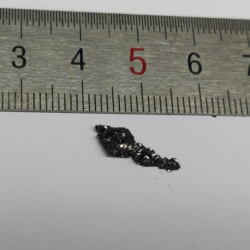
ZrTe₃ Crystals
Price range: $696.09 through $835.32 -
WSSe Crystals
Price range: $835.32 through $1,252.98 -
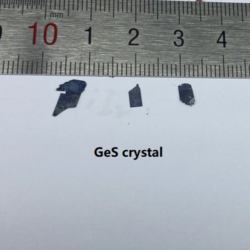
GeS Crystals
Price range: $696.09 through $765.70 -
Bi Crystals
$696.09 -
PdTe₂ Crystals
$696.09